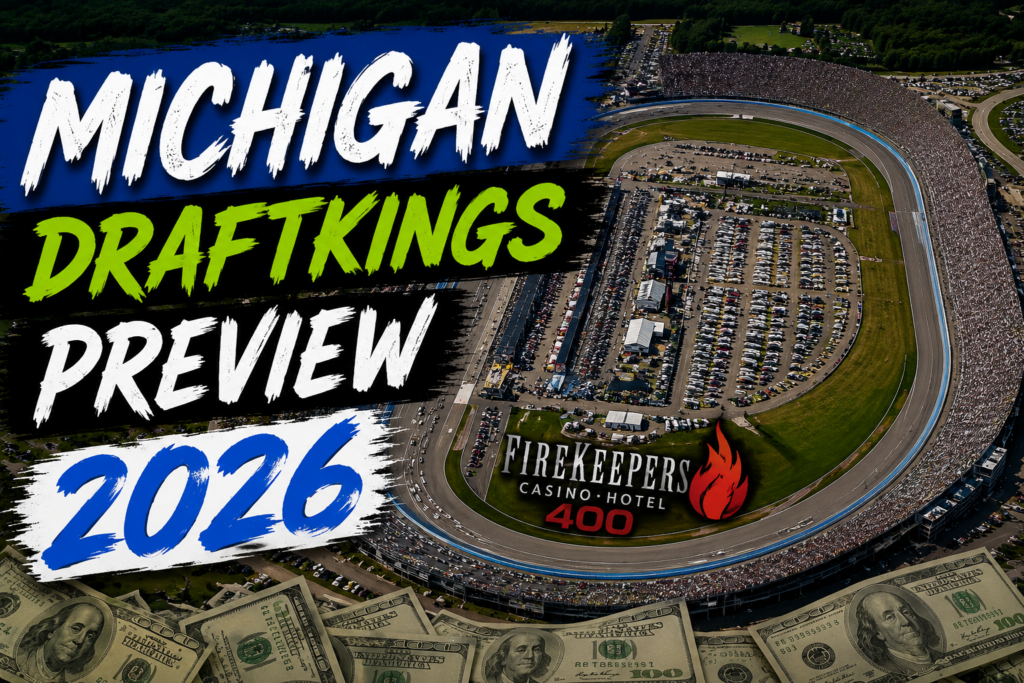
After a week in Nashville, the NASCAR Cup Series heads north to Michigan International Speedway for the FireKeepers Casino 400. Michigan is a two mile D shaped oval located in Brooklyn, Michigan and is widely regarded as one of the fastest tracks on the NASCAR schedule. Thanks to its massive straightaways, sweeping corners, and multiple racing grooves, drivers can often race side by side throughout the field, creating some of the most exciting intermediate track racing of the season.
Michigan’s corner banking measures 18 degrees, which is less aggressive than Daytona and Talladega but still provides plenty of speed. What makes this track unique is its width. Drivers can run the bottom lane, search for speed through the middle, or ride the high line against the wall depending on track conditions. Three wide racing is common, four wide moments happen on restarts, and unlike many modern tracks, fast cars can often work their way forward even after a poor qualifying effort.
Last year’s race provided plenty of action with 11 different drivers taking turns at the front and 15 lead changes throughout the event. William Byron appeared to have one of the strongest cars in the field after leading 98 laps, but a late fuel mileage gamble opened the door for Denny Hamlin to capture the victory. That race served as a reminder that Michigan rewards speed, but strategy can still play a major role in determining who celebrates in Victory Lane.
From a DFS perspective, Michigan is often a track where multiple drivers contribute meaningful dominator points rather than one driver completely controlling the race. With 200 laps scheduled, there are plenty of opportunities for laps led and fastest laps to be spread across several contenders. Finding the right combination of dominators, place differential, and ownership leverage will once again be the key to building tournament winning lineups this weekend.
Last Week Recap and DFS Reflection
Last week at Nashville, Denny Hamlin once again proved why he was the driver to beat. Hamlin led 79 laps on his way to victory and rewarded DFS players with one of the top fantasy performances on the slate. Four of the top six finishers came from the Toyota camp, continuing the strong season the manufacturer has put together.
There were also a few surprises mixed into the final results. Ricky Stenhouse Jr. delivered a fourth place finish, while Shane van Gisbergen brought home an impressive fifth place result, the best oval finish of his NASCAR Cup Series career. Congratulations to SVG, who continues to show growth every time he gets behind the wheel on tracks that were once considered weaknesses.
From a DFS perspective, we felt good about our read on the race. We identified Hamlin as one of the premier dominator candidates and carried plenty of exposure throughout our builds. Unfortunately, DFS is not just about finding the winner. It is about finding the right combination of six drivers, and this was one of those weeks where we simply did not connect all the pieces around him.
We were also overweight on Ross Chastain, whose issues throughout the race resulted in a finish deep in the field. When one of your core plays struggles, it can make building a tournament winning lineup much more difficult, even when you correctly identify the race winner.
That is part of the game and part of the DFS Outsider philosophy. Some weeks the cards fall your way and some weeks they do not. The goal is not to chase results from one race. The goal is to consistently make strong decisions, trust the process, and put yourself in position to capitalize when everything comes together. With Nashville behind us, we turn our attention to Michigan and another opportunity to think differently and build lineups capable of competing for the top of the leaderboard.
Understanding The Data Tables
As always, we begin our research by looking at several key performance metrics and converting them into a simple scoring system that allows us to quickly identify drivers who stand out across multiple categories. For each statistical category, drivers finishing 1st through 10th receive 4 points, 11th through 19th receive 3 points, 20th through 29th receive 2 points, and 30th through the remainder of the field receive 1 point.
Starting position is scored in reverse, rewarding drivers who qualify deeper in the field and offer greater place differential upside. This helps balance raw performance metrics with DFS scoring potential.
The first table breaks down each individual category and assigns the corresponding point values. The second table combines those scores into a total point ranking, giving us a quick snapshot of which drivers appear strongest heading into the weekend.
As always, these tables are not intended to predict the finishing order of the race. They are simply a research tool designed to help identify potential targets, uncover value plays, and provide a starting point for our DFS analysis. Qualifying, practice speeds, ownership projections, and lineup construction will all play an important role before final roster decisions are made.
Driver
Salary
Start Pos
Avg Finish
Laps Led
Driver Rating
Stage Points
Denny Hamlin
$11,000
1
4.3
6
101.8
11
Tyler Reddick
$10,700
3
14.7
22
95.0
7
Kyle Larson
$10,500
7
14.7
43
100.2
15
Ryan Blaney
$10,200
19
19.7
23
84.7
15
Christopher Bell
$10,000
8
21.3
3
77.4
0
Chase Briscoe
$9,700
5
28.3
11
56.5
7
Ty Gibbs
$9,500
4
5.7
3
90.0
16
Chase Elliott
$9,300
6
22.0
48
73.2
9
William Byron
$9,100
9
21.7
118
94.2
34
Chris Buescher
$8,900
14
3.0
65
111.0
17
Carson Hocevar
$8,700
2
19.5
35
88.1
9
Bubba Wallace
$8,500
13
16.0
26
86.4
27
Joey Logano
$8,200
18
23.0
0
63.0
4
Ross Chastain
$8,100
32
12.7
20
88.2
16
Brad Keselowski
$7,900
26
6.3
17
94.6
20
Daniel Suarez
$7,700
11
9.3
19
81.6
14
Ryan Preece
$7,500
27
14.0
0
62.7
5
Erik Jones
$7,300
10
12.3
0
77.3
6
Shane van Gisbergen
$7,200
30
18.0
0
56.8
0
Austin Cindric
$7,000
31
23.7
10
67.0
11
Alex Bowman
$6,900
29
32.0
19
55.0
21
Zane Smith
$6,800
16
7.0
2
74.3
0
Michael McDowell
$6,600
20
24.3
0
44.8
0
Ricky Stenhouse Jr.
$6,500
23
18.0
2
56.8
0
Austin Dillon
$6,300
25
18.3
2
61.3
6
Connor Zilisch
$6,200
34
N/A
N/A
N/A
N/A
AJ Allmendinger
$6,000
25
24.3
0
61.8
3
Josh Berry
$5,900
37
22.7
4
50.7
6
John Hunter Nemechek
$5,700
17
31.5
0
31.1
0
Austin Hill
$5,600
28
28.0
0
39.0
0
Riley Herbst
$5,500
12
25.0
0
36.5
0
Todd Gilliland
$5,300
35
32.7
0
38.2
0
Noah Gragson
$5,200
22
19.5
0
47.9
0
Ty Dillon
$5,000
24
22.0
2
50.4
2
Cole Custer
$4,900
15
30.0
0
31.4
0
Cody Ware
$4,700
33
23.5
1
40.2
2
JJ Yeley
$4,500
36
27.0
0
38.7
0
Driver
Salary
Start Pos
Avg Finish
Laps Led
Driver Rating
Stage Points
Total Points
Brad Keselowski
$7,900
4
4
3
4
4
19
Chris Buescher
$8,900
3
4
4
4
4
19
Ross Chastain
$8,100
4
3
3
4
4
18
Daniel Suarez
$7,700
3
4
3
3
4
17
William Byron
$9,100
2
2
4
4
4
16
Bubba Wallace
$8,500
3
3
3
3
4
16
Kyle Larson
$10,500
2
3
4
4
3
16
Ty Gibbs
$9,500
1
4
2
4
4
15
Ryan Blaney
$10,200
3
2
3
3
4
15
Denny Hamlin
$11,000
1
4
2
4
3
14
Tyler Reddick
$10,700
1
3
3
4
3
14
Alex Bowman
$6,900
4
1
3
2
4
14
Austin Cindric
$7,000
4
2
2
3
3
14
Carson Hocevar
$8,700
1
2
4
3
3
13
Chase Elliott
$9,300
2
2
4
2
3
13
Austin Dillon
$6,300
4
3
2
2
2
13
Ryan Preece
$7,500
4
3
1
2
2
12
Josh Berry
$5,900
4
2
2
2
2
12
Cody Ware
$4,700
4
2
2
2
2
12
Zane Smith
$6,800
2
4
2
2
1
11
Erik Jones
$7,300
2
3
1
3
2
11
Chase Briscoe
$9,700
1
2
3
2
3
11
Shane van Gisbergen
$7,200
4
3
1
2
1
11
AJ Allmendinger
$6,000
4
2
1
2
2
11
Ricky Stenhouse Jr.
$6,500
3
3
2
2
1
11
Ty Dillon
$5,000
3
2
2
2
2
11
Christopher Bell
$10,000
2
2
2
3
1
10
Joey Logano
$8,200
3
2
1
2
2
10
Noah Gragson
$5,200
3
2
1
2
1
9
Austin Hill
$5,600
4
2
1
1
1
9
JJ Yeley
$4,500
4
2
1
1
1
9
Michael McDowell
$6,600
2
2
1
2
1
8
Riley Herbst
$5,500
3
2
1
1
1
8
Todd Gilliland
$5,300
4
1
1
1
1
8
John Hunter Nemechek
$5,700
2
1
1
1
1
6
Cole Custer
$4,900
2
1
1
1
1
6
Connor Zilisch
$6,200
4
0
0
0
0
4
Initial Thoughts From The Data Table
One of the first things that jumps off the page this week is how much value appears to be concentrated in the mid range of the pricing structure. While the expensive drivers certainly have race winning upside, many of the strongest point totals in our research model belong to drivers priced well below the elite tier. In fact, you have to scroll several spots down the rankings before reaching many of the five figure salaries, which immediately creates some interesting lineup construction possibilities.
Michigan has historically been a track where speed matters, but it is not always a race where one driver completely dominates the slate. With multiple grooves, long green flag runs, varying pit strategies, and plenty of opportunities for drivers to move through the field, dominator points often get spread across several contenders rather than being concentrated in a single car. That makes place differential and overall lineup construction even more important than usual.
Among the elite drivers, William Byron, Kyle Larson, Denny Hamlin, and Tyler Reddick all remain firmly in the player pool. Each has the speed capable of leading laps and competing for the win. Carson Hocevar also continues to show impressive speed, but starting near the front limits some of the place differential upside that normally makes him so attractive for DFS purposes.
The area that continues to draw the most attention is the group of mid priced drivers starting deeper in the field. Brad Keselowski, Ross Chastain, Alex Bowman, Austin Cindric, Ryan Blaney, Daniel Suarez, Chris Buescher, and Bubba Wallace all stand out as drivers who possess a combination of strong historical performance, reasonable salaries, and potential position gain throughout the race. It would not be surprising to see several of these drivers become core pieces of tournament builds this weekend.
As always, the goal is not simply identifying the fastest car. The goal is finding the right combination of dominator points, place differential, salary efficiency, and ownership leverage. Early indications suggest Michigan could once again reward balanced roster construction over simply loading up on the most expensive names available
Frankie’s Fade of the week
Hey meatballs, yeah, I’m talking to you. Before I tell you who I’m fading this week, take a deep breath. Carson Hocevar at $8,700. Now listen, the kid’s got speed, he’s got talent, he likes to trade paint, and he’s got balls of steel. I get it. Believe me, I get it.
But the problem isn’t Carson Hocevar. The problem is everybody loves a little Carson Hocevar magic. There are gonna be 10,000 meatballs clicking that same button this week, and Frankie ain’t interested in trading paint with 10,000 other meatball lineups. If I’m gonna beat a tournament, I want to do it my way, not standing shoulder to shoulder with half the DFS lobby.
The only meatballs I want to be hanging around are at Ma’s Sunday spaghetti dinner, swimming in marinara sauce next to a pile of linguine. Carson might get there, and if he does, good for him. But Frankie is taking a different road this week. Capisce? I’m out.
Final Thoughts
My final thoughts this week are pretty simple. After going through the data, there are probably close to ten drivers that I can eliminate from my player pool altogether. Once I get past that point, the rest of the week becomes an ownership game and a lineup construction game. There are plenty of drivers who can have strong days, which means building unique combinations is likely going to be more important than simply identifying the race winner.
From a lineup construction standpoint, I expect to lean more heavily on balanced builds. I will certainly have some stars and scrubs lineups mixed in, and I may even pair two expensive drivers together in certain builds, but I do not expect that to be my primary approach. Instead, I find myself gravitating toward lineups built around strong mid range options with one elite driver mixed in rather than forcing multiple five figure salaries into every roster.
The drivers that continue to stand out to me are Ross Chastain, Brad Keselowski, Chris Buescher, and several of the other names near the top of our data table. Those are the types of drivers I expect to build around while mixing and matching exposure to other pieces throughout the player pool. Michigan often turns into a race where strategy, pit cycles, and changing track conditions create opportunities for multiple drivers to score well, which makes diversification even more important.
I also expect to be a little lighter on overall volume this week. While I like the slate, Michigan has always felt like a higher variance track for me, somewhat similar to the unpredictability we see at superspeedways. Personally, I tend to perform better on some of the specialty tracks where the paths to success are a little easier to narrow down. That said, high variance also creates opportunity, and this feels like a week to get a little uncomfortable. Leave some salary on the table. Build a few lineups that look different. Take some chances.