
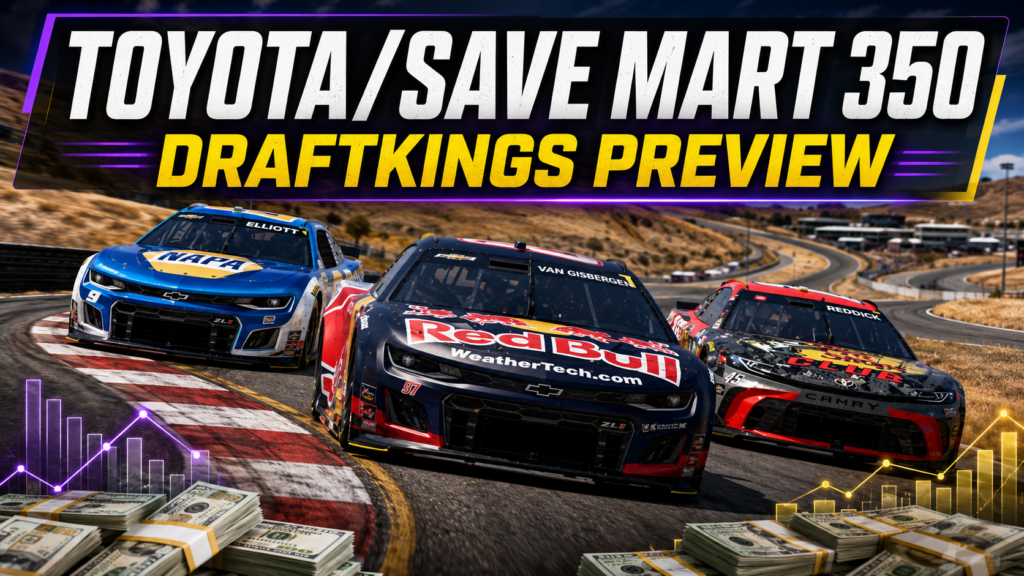

Sonoma is one of those tracks where the schedule immediately feels different. This is not a mile and a half where dirty air, track position, and pit cycles tell the whole story. This is a technical road course in wine country where drivers have to actually drive the race car. The braking zones matter. The rhythm matters. The wheel hop matters. The patience matters. The ability to not panic when somebody is leaning on your bumper into a corner matters.
The Cup Series heads to Sonoma Raceway for the Toyota/Save Mart 350, a 1.99 mile road course with 10 turns, elevation change, tight corners, heavy braking zones, and sections where one mistake can ruin an entire day. Sonoma is not a wide open road course where drivers can just out horsepower people down long straightaways. This place forces them to be precise. It forces them to hit marks. It forces them to manage tires, brakes, aggression, and track position at the same time.
That is what makes Sonoma fun from a DFS standpoint. Road course racing exposes people. Some drivers are comfortable here. Some drivers survive here. Some drivers look completely lost the second they have to brake, rotate, get back to throttle, and not cook the tires over a full run. This is a skill track. It is not just about who has the fastest car. It is about who can repeatedly make the right decisions in heavy braking zones, who can stay disciplined on corner exit, and who can avoid the kind of mistakes that turn a top 10 car into a 28th place disaster.
The key passing zones at Sonoma are going to come where drivers can set someone up under braking. Turn 7 is always one of the big ones. It is a tighter section of the course where drivers can outbrake someone, force the issue, or completely overcook the corner and pay for it. Turn 11 is another major trouble spot because it is a slow, heavy braking corner at the end of the lap where patience and aggression collide. Everybody sees opportunity there. Not everybody survives it.
That is where Sonoma gets nasty. Passing is possible, but it is not easy. A lot of these moves are not clean little Sunday drives through wine country. They are late braking, bumper pressure, dive bombs, blocked exits, and drivers trying to decide how much of the other guy’s race car they are willing to use. That creates DFS chaos, because one restart can shuffle the field, one missed braking point can stack up three rows, and one driver getting impatient can wreck multiple lineups at the same time.
The surface and elevation also matter at Sonoma. This track has enough character that drivers cannot just treat every corner the same. The car has to be stable under braking. It has to rotate through the slower corners. It has to have enough forward drive off corner exit. If a driver is fighting wheel hop or cannot get the car pointed, they are going to spend the entire race defending instead of attacking. That is a miserable way to live at a road course.
This is also why the usual road course names always get attention. We know the profile. We know the types of drivers the field is going to gravitate toward. The guys with braking skill. The guys with sports car backgrounds. The guys who can manage a technical course without beating themselves. But this is where DFS gets more interesting than just saying, “Play the good road course drivers.” Everybody knows who the road course guys are. The edge comes from figuring out which ones are priced correctly, which ones carry too much ownership, and which ones actually fit the way this slate is going to score.
And of course, that conversation starts with Shane van Gisbergen. Whether people are tired of hearing it or not, he has become the road course problem. He is the NASCAR version of the Scottie Scheffler Conundrum on these tracks. Everybody knows he is elite. Everybody knows he can win. Everybody knows he can make the field look silly when the track demands braking, rhythm, and road racing instincts. The question is not whether SVG is good. The question is whether the price tag, ownership, and lineup construction make him the right tournament play.
That is where DraftKings pricing has started to get ridiculous. In the O’Reilly Series race, Shane van Gisbergen was priced at $15,000. He won the race, and he still was not even in the winning lineup. That is absurd. When a driver can win the actual race and still not be optimal because the salary is that bloated, that tells you the pricing has gone too far.
I understand the idea behind it. DraftKings wants to suppress ownership on massive favorites. They want to make players uncomfortable. They want to force decisions. That part makes sense. But there is a difference between making a driver expensive and making the price tag so ridiculous that it almost removes him from proper lineup construction. At that point, you are not creating strategy. You are shrinking the slate.
I would rather see the pricing opened up a little bit. Let people play the heavy favorite. Let him be popular. Let the field jam him in if they want to. Then, if that driver fails, the slate explodes open for the people willing to gamble against him. That is a much better DFS game than pricing someone into outer space and making the entire conversation about whether the salary is even functional.
That is the decision Sonoma forces on us this week. This race is going to be technical, uncomfortable, and probably frustrating at times. It is going to reward skill, but it is also going to punish lazy DFS thinking. You cannot just click names because they are good on road courses and call it a lineup. You have to understand where the slate can break, where the trouble can happen, and how salary changes the entire conversation.Sonoma is not just another race. It is a test. It tests the drivers, it tests the teams, and it tests DFS players who think the obvious answer is always the right answer
.
Last Week Recap and DFS Reflection
Last week at the Anduril 250 Race the Base at Naval Base Coronado, NASCAR tried something different, and I respect the hell out of that. The idea of racing on a naval base was cool, the setting was unique, and it gave the sport a different feel than the same old weekly stop. But from a racing standpoint, I came away with mixed feelings. Some people loved it, and I understand why, but for me the course felt a little too tight in too many places and just did not always feel like a true NASCAR race.
There were too many stoppages, too many awkward sections, and too many moments where the course seemed to create problems instead of creating great racing. That does not mean the event was a failure. I actually like the concept a lot. I just think if NASCAR is going to keep doing something like this, the layout itself needs some work so the racing can breathe a little more.
As for the actual race, Corey Heim showed it was Heim time with the big boys. He started 13th, capitalized on a late race mistake by Tyler Reddick, and took the lead with three laps to go. For a win to come in just his 13th Cup start is pretty damn impressive, especially when we already know what he has done in the lower series. Lets just say it. This guy can drive the wheels off a race car. I am excited to see what he is going to do here in the cup series over the next couple years.
From a DFS standpoint, it was a mixed bag for me. I had some Corey Heim, but not enough to make the day super profitable. We also saw some interesting names run well up front, including Bubba Wallace and Kyle Larson, two guys who are not always the first names people think of when breaking down road course strength. That is an important reminder heading into Sonoma. Road course skill matters, but track position, chaos, late mistakes, and race flow can still flip the slate in a hurry.
How The Ratings Work
For the NASCAR breakdown, I use a simple ranking system to help separate track history, starting position, salary, and DFS value. Average finish, laps led, stage points, driver rating, DraftKings salary, and starting position all tell a different part of the story. No single metric is perfect by itself, but when you stack them together, you start to see which drivers have real strength, which drivers have track history, which drivers have place differential upside, and which drivers are priced into a tough decision.
Starting position is ranked in reverse order because of DraftKings scoring. A driver starting deeper in the field has more opportunity to score place differential points by moving forward, while a driver starting near the front has less room to gain and more risk if things go wrong. That does not mean front starters are bad plays. It just means they usually need laps led, fastest laps, or a strong finishing position to justify the risk. On a track like Sonoma, where passing can be difficult but mistakes can happen fast, starting position becomes a major part of lineup construction.
The point system is designed to keep things simple. Drivers are ranked in each category, and the better the ranking, the more points they receive. This is not meant to spit out automatic plays. It is meant to give us a cleaner starting point before we apply ownership, salary, strategy, and tournament leverage.
For this week’s 36 driver field, the scoring system works like this:
1st through 10th earns 4 points
11th through 19th earns 3 points
20th through 29th earns 2 points
30th through 36th earns 1 point
After that, we can total everything up and see which drivers pop across the full profile. Then the real DFS work starts, because the highest rated driver is not always the best tournament play. Price, starting position, ownership, and slate context still matter. This is just to give a snapshot of who checks what boxes and isn’t any type of formal ranking system. I use it to assess value and starting points to my lineups.
| Driver | Salary | Start | Avg Finish | Laps Led | Stage Points | Driver Rating |
|---|---|---|---|---|---|---|
| Shane van Gisbergen | $14,000 | 6th | 1.0 | 97 | 19 | 149.3 |
| Tyler Reddick | $10,500 | 11th | 15.7 | 35 | 15 | 87.6 |
| Connor Zilisch | $10,000 | 17th | N/A | N/A | N/A | N/A |
| Kyle Larson | $9,500 | 3rd | 14.7 | 22 | 17 | 98.3 |
| Michael McDowell | $9,300 | 4th | 4.3 | 4 | 14 | 101.4 |
| Ty Gibbs | $9,100 | 1st | 20.7 | 0 | 5 | 72.1 |
| Chase Briscoe | $8,900 | 7th | 21.7 | 2 | 9 | 68.6 |
| Chris Buescher | $8,700 | 15th | 7.7 | 32 | 17 | 106.1 |
| Ryan Blaney | $8,500 | 16th | 24.7 | 1 | 14 | 74.6 |
| William Byron | $8,400 | 13th | 17.3 | 0 | 14 | 75.2 |
| A.J. Allmendinger | $8,200 | 8th | 10.0 | 3 | 13 | 93.1 |
| Chase Elliott | $8,000 | 18th | 4.0 | 10 | 8 | 107.0 |
| Christopher Bell | $7,700 | 14th | 7.7 | 1 | 10 | 99.2 |
| Daniel Suarez | $7,500 | 21st | 16.7 | 0 | 3 | 67.1 |
| Ross Chastain | $7,400 | 5th | 13.0 | 5 | 22 | 90.0 |
| Carson Hocevar | $7,200 | 2nd | 24.5 | 0 | 0 | 53.2 |
| Denny Hamlin | $7,100 | 9th | 31.3 | 33 | 10 | 56.2 |
| Ryan Preece | $7,000 | 19th | 14.3 | 0 | 9 | 75.1 |
| Bubba Wallace | $6,900 | 26th | 21.0 | 0 | 15 | 56.4 |
| Joey Logano | $6,800 | 10th | 11.0 | 16 | 11 | 80.4 |
| Zane Smith | $6,600 | 24th | 25.7 | 0 | 0 | 54.6 |
| Alex Bowman | $6,500 | 22nd | 16.3 | 0 | 8 | 75.1 |
| Riley Herbst | $6,400 | 25th | 25.0 | 0 | 0 | 53.7 |
| Austin Hill | $6,300 | 12th | N/A | N/A | N/A | N/A |
| Austin Cindric | $6,200 | 23rd | 25.7 | 0 | 0 | 50.3 |
| Todd Gilliland | $6,100 | 29th | 18.7 | 0 | 4 | 60.9 |
| Brad Keselowski | $6,000 | 35th | 13.3 | 0 | 5 | 75.4 |
| John Hunter Nemechek | $5,900 | 20th | 28.5 | 0 | 0 | 35.1 |
| Austin Dillon | $5,800 | 30th | 25.3 | 0 | 5 | 54.3 |
| Erik Jones | $5,700 | 32nd | 26.7 | 0 | 4 | 43.2 |
| Ricky Stenhouse Jr. | $5,500 | 33rd | 23.0 | 0 | 20 | 62.6 |
| Noah Gragson | $5,400 | 34th | 31.5 | 0 | 0 | 37.4 |
| Cole Custer | $5,300 | 27th | 23.0 | 0 | 0 | 44.7 |
| Josh Berry | $5,200 | 28th | 22.5 | 0 | 0 | 44.2 |
| Ty Dillon | $5,100 | 31st | 20.0 | 0 | 9 | 51.2 |
| Cody Ware | $5,000 | 36th | 34.0 | 0 | 0 | 27.8 |
| Driver | Salary | Start Pts | Avg Finish Pts | Laps Led Pts | Stage Pts | Rating Pts | Total Points |
|---|---|---|---|---|---|---|---|
| Chase Elliott | $8,000 | 3 | 4 | 4 | 3 | 4 | 18 |
| Chris Buescher | $8,700 | 2 | 4 | 4 | 4 | 4 | 18 |
| Joey Logano | $6,800 | 2 | 4 | 4 | 3 | 4 | 17 |
| Ross Chastain | $7,400 | 1 | 4 | 4 | 4 | 4 | 17 |
| A.J. Allmendinger | $8,200 | 2 | 4 | 4 | 3 | 4 | 17 |
| Michael McDowell | $9,300 | 1 | 4 | 4 | 4 | 4 | 17 |
| Tyler Reddick | $10,500 | 2 | 3 | 4 | 4 | 4 | 17 |
| Shane van Gisbergen | $14,000 | 1 | 4 | 4 | 4 | 4 | 17 |
| Christopher Bell | $7,700 | 2 | 4 | 3 | 3 | 4 | 16 |
| Kyle Larson | $9,500 | 1 | 3 | 4 | 4 | 4 | 16 |
| Ricky Stenhouse Jr. | $5,500 | 4 | 2 | 1 | 4 | 3 | 14 |
| Brad Keselowski | $6,000 | 4 | 4 | 1 | 2 | 3 | 14 |
| Ryan Preece | $7,000 | 3 | 4 | 1 | 3 | 3 | 14 |
| Ryan Blaney | $8,500 | 2 | 2 | 3 | 4 | 3 | 14 |
| Ty Dillon | $5,100 | 4 | 3 | 1 | 3 | 2 | 13 |
| Alex Bowman | $6,500 | 3 | 3 | 1 | 3 | 3 | 13 |
| Bubba Wallace | $6,900 | 3 | 3 | 1 | 4 | 2 | 13 |
| William Byron | $8,400 | 2 | 3 | 1 | 4 | 3 | 13 |
| Todd Gilliland | $6,100 | 4 | 3 | 1 | 2 | 2 | 12 |
| Denny Hamlin | $7,100 | 2 | 1 | 4 | 3 | 2 | 12 |
| Daniel Suarez | $7,500 | 3 | 3 | 1 | 2 | 3 | 12 |
| Chase Briscoe | $8,900 | 1 | 2 | 3 | 3 | 3 | 12 |
| Austin Dillon | $5,800 | 4 | 2 | 1 | 2 | 2 | 11 |
| Cole Custer | $5,300 | 4 | 2 | 1 | 1 | 2 | 10 |
| Ty Gibbs | $9,100 | 1 | 3 | 1 | 2 | 3 | 10 |
| Josh Berry | $5,200 | 4 | 2 | 1 | 1 | 1 | 9 |
| Erik Jones | $5,700 | 4 | 1 | 1 | 2 | 1 | 9 |
| Austin Cindric | $6,200 | 3 | 2 | 1 | 1 | 2 | 9 |
| Riley Herbst | $6,400 | 3 | 2 | 1 | 1 | 2 | 9 |
| Zane Smith | $6,600 | 3 | 2 | 1 | 1 | 2 | 9 |
| Cody Ware | $5,000 | 4 | 1 | 1 | 1 | 1 | 8 |
| Noah Gragson | $5,400 | 4 | 1 | 1 | 1 | 1 | 8 |
| John Hunter Nemechek | $5,900 | 3 | 1 | 1 | 1 | 1 | 7 |
| Carson Hocevar | $7,200 | 1 | 2 | 1 | 1 | 2 | 7 |
| Austin Hill | $6,300 | 2 | 1 | 1 | 1 | 1 | 6 |
| Connor Zilisch | $10,000 | 2 | 1 | 1 | 1 | 1 | 6 |
Table Takeaways
The biggest takeaway from the tables is pretty simple. There is value all over this slate. There are plenty of mid priced plays that rate well, carry real upside, and make lineup construction a lot more interesting than just asking whether Shane van Gisbergen wins the race.
That is still the elephant in the room. Do you play SVG at $14,000 or not? If you do, you are going to need serious value around him so you can still jam in as many of these strong mid tier plays as possible. If you do not, the balanced build opens up fast, and you can start stacking together a lot of drivers who check multiple boxes.
The value range is what really stands out to me. Brad Keselowski at $6,000, Ricky Stenhouse Jr. at $5,500, Joey Logano at $6,800, Ryan Preece at $7,000, and Todd Gilliland at $6,100 all give you ways to build lineups that do not feel completely forced. There is a lot of playable salary on this slate, and that is what makes the SVG decision so important.
Pricing Tier Targets
Shane van Gisbergen $14,000, with the field
This is Sonoma, this is a technical road course, and he is the technician. The ownership is going to be massive, but I am not trying to get too cute with the best road course driver in the field. I will be around the field on SVG and try to get different elsewhere.
Tyler Reddick $10,500, over
If you want to get different in the high end range without just eating the SVG chalk, Reddick makes a lot of sense. We know what he can do on road courses, and if this race gets chaotic, he has the talent to take advantage.
Kyle Larson $9,500, over
I am fine being a little overweight on Larson because he is Kyle Larson. He is good everywhere, he has winning upside at almost every track type, and he gives you another elite ceiling path if SVG does not completely bury the slate.
Michael McDowell $9,300, over
This is a horse for the course type play. McDowell likes this track, he is strong on road courses, he qualified well, and he checks a lot of boxes outside of the starting position risk. If he runs up front all day, it is very possible he needs to be in the winning lineup.
Chris Buescher $8,700, over
This is one of the best value plays on the slate. Buescher has been excellent at Sonoma, the track history is strong, and the starting position makes me like him even more. This is exactly the kind of mid priced play that makes the balanced build so appealing.
William Byron $8,400, under
I am just not a Byron guy, and I am usually underweight on him. He is a good driver, but at this price, I have a hard time clicking the button when there are other drivers around him and below him that I like more for this slate.
Chase Elliott $8,000, over
This might be my favorite play on the slate. The price is too cheap for the road course ability, the starting position gives him place differential upside, and his history at Sonoma speaks for itself. With three top five finishes here, Elliott is a smash play for me.
Christopher Bell $7,700, over
Bell starts in the teens, has enough road course ability, and the price gives you flexibility whether you are building with SVG or going balanced. I like the upside he brings at this salary.
Daniel Suarez $7,500, over
Suarez has shown enough road course ability to be firmly in play here. He does not have to dominate the race at this price, and if he stays clean and moves forward, he can absolutely be part of the right lineup construction.
Todd Gilliland $6,100, over
This is a DFS Outsider play. Gilliland does fairly well here, he is cheap, and he gives you the kind of salary relief that can make the SVG builds work. I think he can do enough to matter, and I would not be shocked if he sneaks into the optimal lineup.
Brad Keselowski $6,000, over
This is another DFS Outsider play. Keselowski is not a road course king, but he starts so far back that the place differential path is obvious, and he has shown he can run decent here. At this price, if he just moves forward and survives, he could be one of the better salary savers on the slate.
Joey Logano $6,800, with the field
Logano is not the sexiest click, but the price is fair, the track history is good enough, and he has a path to being useful if he stays clean. He is not a priority over some of the other values, but he is absolutely playable.
Frankie’s Fade of the Week
Frankie’s Fade of the Week is Shane van Gisbergen at $14,000.
Hey meatballs, yeah, yeah, yeah, I know. Frankie fades SVG at road courses, and that is why Frankie is usually broke by lap 20 at these places. I get it. The guy is a wheelman. The guy can brake later than my Uncle Sal paying back a gambling debt. He is the best road course driver in the field, and everybody knows it.
But last week, it actually worked. SVG got caught up in the mess, Frankie cashed a few tickets, and suddenly I was eating veal osso buco like I owned the joint. Ma thought I hit the lottery. I told her, “Relax, sweetheart, I faded the road course monster one time and lived to tell about it.”
Now he is $14,000 at Sonoma, and DraftKings wants you to sell half your roster, your cousin’s Buick, and maybe a kidney just to click the button. Can he win? Of course he can win. He might win by so much they need to check if he took a shortcut through Napa. But at that price, he has to do everything. He has to win, dominate, and drag five bargain bin meatballs into the winning lineup with him.
So Frankie is fading SVG again. Am I scared? Absolutely. Am I stupid? Probably. But Outsiders do not get paid by clicking the same button as everybody else.
Final Thoughts
This slate feels a lot like a Scottie Scheffler golf field. The price makers turned the entire conversation into one guy, and honestly, I hate when slates get built that way. Shane van Gisbergen is the best road course driver in this field, but at $14,000, DraftKings made the entire slate about whether you play him or not. That is the game they gave us, so now we have to play the game.
For me, because I play a lot of lineups, I am still going to have exposure to SVG. I am not pretending he cannot dominate this race, because that would be stupid. But I also think you have to find different ways to build. Instead of always starting at the top and trying to jam pieces around him, start in the middle. Build balanced. Look at the road course guys. Look at the drivers with moving upside. Look at the guys who can survive Sonoma, stay clean, and still give you a path to a strong finish.
If you are going against SVG, do it with purpose. Favor drivers who can actually run well here, not just random punts because they are cheap. This is a technical track, so I want road course ability, place differential upside, and drivers who can avoid the big mistake. Leaving some salary on the table makes sense this week too, because if everybody is building around the same expensive starting point, you need to create a different path.
This is where we fall back on the DFS Outsider rules. Ownership is the opponent. Good picks do not win tournaments by themselves. Lineup construction matters. First place pays differently. You do not have to build the prettiest lineup. You have to build the lineup that can win if the slate breaks your way.
So do a little razzle dazzle, build with some intent, and hope we pick the right damn lineup. Best of luck to everybody this week. I have some major golf sweats going into the final day, a lot of Scottie Scheffler, some strong lineups, and a couple World Cup slash Scottie Scheffler bets stacked on top of the Wyndham Clark bets from last week. We are looking live. Now let’s kick some ass, take down a GPP, and remember the only rule that really matters.
It only takes one