
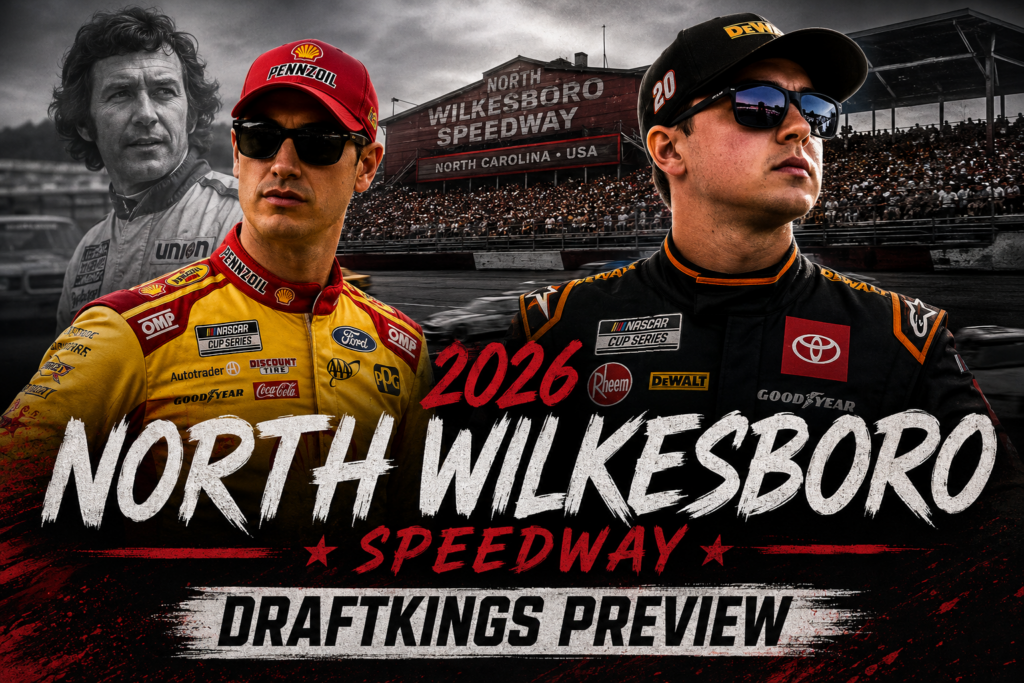

NASCAR is going back to its roots this weekend for the Window World 450 at North Wilkesboro Speedway, a 450 lap points race around one of the most historic short tracks in the sport. The 0.625 mile oval hosted Cup racing from 1949 through 1996, usually appearing on the schedule twice each season before NASCAR abandoned the facility during its push toward larger tracks and expanding markets. After sitting mostly dormant for decades, North Wilkesboro was revived for the All Star Race in 2023 and remained the home of that exhibition through 2025. Now we are getting the first points paying Cup race here in 30 years, and the place still carries that old school, good old boy atmosphere that makes short track racing feel completely different from another cookie cutter intermediate.
This is a narrow, relatively flat track with approximately 14 degrees of banking in the corners, short straightaways and a natural elevation change that makes each end drive differently. Drivers travel downhill on one straightaway and climb back uphill on the other, creating different braking, rotation and acceleration demands throughout the lap. The Truck Series race showed us that both grooves can work, but neither lane makes passing easy. Some drivers could keep the truck planted on the bottom, while others generated more momentum by opening the corner and driving off from the upper groove. Faster trucks occasionally became trapped behind slower traffic, but once they completed the pass and reached clean air, they were able to create separation rather quickly. Chandler Smith provided the perfect example of what could happen Sunday, winning the race and dominating the second half with tremendous speed. Passing was not always easy for him, but once he completed a move and got into clean air, he could pull away almost immediately. His ability to get the truck pointed, maintain rear grip and accelerate hard off the corner showed exactly how important drive off speed will be at North Wilkesboro.
The North Wilkesboro that NASCAR returned to in 2023 was basically the old speedway brought back from the dead, complete with fresh paint, repaired grandstands and an ancient racing surface that had not been completely repaved since 1981. That changed before the 2024 All Star Race when the track received a full repave for the first time in more than 40 years. The surface we have today is no longer brand new, but it is still much smoother and more predictable than the worn out pavement used during the 2023 return. The encouraging part is that the asphalt has accepted rubber well and the racing groove has begun widening faster than we normally see following a repave. It has retained some of North Wilkesboro’s character, but we should place considerably more weight on the 2024 and 2025 All Star races than anything that happened on the completely different 2023 surface.
Those two All Star races also demonstrated exactly why track position and dominator speed will control this slate. Joey Logano started from the pole and led 199 of 200 laps in 2024, turning the race into a complete ass kicking once he controlled the clean air. He returned in 2025 and led a race high 139 of 250 laps before Christopher Bell used the late caution and a physical pass to take the victory. Ross Chastain, Alex Bowman, Chase Elliott, William Byron and Tyler Reddick also finished inside the top seven, while Brad Keselowski and Christopher Bell controlled their respective heat races. Those results reinforce the idea that this is not necessarily a track where a driver can qualify poorly, casually work through the field and become a dominator later. Starting position, early track position and the ability to immediately control the race are going to matter.
Single Lap Practice Rank measures each driver’s fastest individual lap and gives us the best look at immediate short run speed. 10 Lap Average Rank measures the fastest average over 10 consecutive laps and is the more useful indicator of sustained speed, rear grip and drive off over a run. The table is sorted by DraftKings salary, highest to lowest. A dash means the driver did not compete in that All Star Race or did not complete enough consecutive practice laps to qualify for the ranking. Qualifying was canceled, so the starting order was determined by NASCAR’s performance metric rather than qualifying speeds.
North Wilkesboro DraftKings Data
| Driver | DK Salary | Start | 2024 All Star Finish | 2025 All Star Finish | Combined All Star Laps Led | Single Lap Rank | 10 Lap Rank |
|---|---|---|---|---|---|---|---|
| Denny Hamlin | $11,000 | 7th | 2nd | 12th | 0 | 2nd | 4th |
| Ryan Blaney | $10,700 | 1st | 5th | 16th | 0 | 11th | 5th |
| Kyle Larson | $10,500 | 27th | 4th | 21st | 5 | 7th | 3rd |
| Christopher Bell | $10,200 | 3rd | 17th | 1st | 28 | 1st | 1st |
| William Byron | $9,900 | 15th | 19th | 6th | 12 | 4th | 2nd |
| Chase Elliott | $9,700 | 10th | 8th | 5th | 0 | 5th | 19th |
| Joey Logano | $9,500 | 11th | 1st | 2nd | 338 | 9th | 8th |
| Tyler Reddick | $9,200 | 5th | 14th | 7th | 0 | 31st | 28th |
| Chase Briscoe | $8,900 | 30th | Did Not Race | 9th | 0 | 28th | 17th |
| Carson Hocevar | $8,700 | 4th | Did Not Race | 11th | 0 | 15th | 30th |
| Ty Gibbs | $8,500 | 2nd | 13th | Did Not Race | 0 | 6th | 11th |
| Chris Buescher | $8,300 | 9th | 3rd | 10th | 0 | 10th | 20th |
| Ross Chastain | $8,100 | 13th | 7th | 3rd | 0 | 3rd | 7th |
| Bubba Wallace | $7,900 | 26th | 6th | Did Not Race | 0 | 18th | 26th |
| Ryan Preece | $7,700 | 21st | Did Not Race | Did Not Race | 0 | 21st | 21st |
| Brad Keselowski | $7,600 | 23rd | 16th | 22nd | 63 | 33rd | 33rd |
| Daniel Suárez | $7,400 | 17th | 15th | 23rd | 0 | 19th | 35th |
| Austin Cindric | $7,200 | 14th | Did Not Race | 18th | 1 | 12th | 12th |
| Josh Berry | $7,100 | 28th | Did Not Race | 17th | 0 | 8th | 16th |
| Alex Bowman | $7,000 | 25th | Did Not Race | 4th | 1 | 16th | 9th |
| Shane van Gisbergen | $6,800 | 8th | Did Not Race | Did Not Race | 0 | 17th | 13th |
| Erik Jones | $6,600 | 6th | Did Not Race | Did Not Race | 0 | 26th | 31st |
| Zane Smith | $6,500 | 29th | Did Not Race | Did Not Race | 0 | 23rd | 18th |
| Michael McDowell | $6,400 | 16th | 9th | Did Not Race | 0 | 27th | 29th |
| Austin Dillon | $6,300 | 12th | Did Not Race | 14th | 0 | 22nd | 15th |
| Austin Hill | $6,100 | 33rd | Did Not Race | Did Not Race | 0 | 34th | 32nd |
| Connor Zilisch | $6,000 | 32nd | Did Not Race | Did Not Race | 0 | 13th | 6th |
| Riley Herbst | $5,800 | 34th | Did Not Race | Did Not Race | 0 | 14th | 10th |
| Noah Gragson | $5,700 | 31st | 11th | 13th | 0 | 32nd | 23rd |
| Todd Gilliland | $5,600 | 18th | Did Not Race | Did Not Race | 0 | 20th | 22nd |
| AJ Allmendinger | $5,500 | 35th | 18th | Did Not Race | 0 | 30th | 36th |
| John Hunter Nemechek | $5,400 | 19th | Did Not Race | 19th | 0 | 24th | 24th |
| Ricky Stenhouse Jr. | $5,200 | 24th | 20th | 15th | 0 | 29th | 25th |
| Cole Custer | $5,100 | 20th | Did Not Race | Did Not Race | 0 | 25th | 14th |
| Ty Dillon | $5,000 | 22nd | Did Not Race | Did Not Race | 0 | 35th | 27th |
| Cody Ware | $4,800 | 36th | Did Not Race | Did Not Race | 0 | 36th | 34th |
| Chad Finchum | $4,500 | 37th | Did Not Race | Did Not Race | 0 | 37th | — |
Data Interpretation
The first thing that jumps off this chart is that Joey Logano is going to attract plenty of ownership, and it is not difficult to understand why. His 2026 season has not been anything special, but North Wilkesboro has clearly been one of his best tracks since NASCAR returned. Logano won the 2024 All Star Race, finished second in 2025 and led an absurd 338 combined laps across those two events. He was also solid in practice and will start 11th, giving him enough room to score some place differential while still being close enough to the front to take control of the race. The practice numbers were not dominant, but once the green flag drops, we already know what Logano can do in clean air at this track. He is one of the clearest possible dominators on the slate.
My preferred dominator may be Christopher Bell, who has almost everything we are looking for this weekend. Bell won the 2025 All Star Race, ranked first in both single lap and 10 lap practice speed and will begin the race from the third position. He should have an opportunity to get to the lead immediately, and unlike several drivers starting near the front, his long run practice speed supports the idea that he can stay there. William Byron also deserves serious consideration after ranking fourth in single lap speed and second over 10 consecutive laps. Byron starts 15th, which may prevent him from leading the opening portion of the race, but it gives him place differential upside to go along with legitimate race winning speed. He looks like a potential cornerstone who can move forward early and eventually become a dominator.
Ross Chastain may be my favorite option below the elite salary range. He starts 13th at only $8,100 after ranking third in single lap practice speed and seventh over 10 laps. He also finished seventh here in 2024 before improving to third in the 2025 All Star Race. Chastain has shown that he understands how to get around North Wilkesboro, and his practice speed suggests the car is capable of moving forward again. Bubba Wallace does not have the same practice numbers, but he starts 26th and finished sixth in the 2024 All Star Race, giving him obvious move up potential. Alex Bowman is another strong place differential candidate from the 25th position after ranking ninth in 10 lap speed and finishing fourth here last season.
Several cheaper drivers also created legitimate interest during practice. Connor Zilisch starts 32nd but ranked 13th in single lap speed and sixth over 10 laps, making him one of the most intriguing dark horse candidates on the entire slate. He did not earn that starting position through a traditional qualifying session, so I am much more interested in what the practice speed tells us than the number beside his name on the starting grid. Riley Herbst offers a similar profile from 34th after ranking 14th in single lap speed and 10th over 10 laps. Cole Custer starts 20th and ranked 14th in long run speed, which is especially interesting for a driver with extensive short track experience. None of these drivers are guaranteed to convert practice speed into a strong finish, but they give us inexpensive ways to create salary flexibility without blindly throwing darts at the back of the field.
Chase Briscoe is another higher priced place differential option who deserves consideration. He begins 30th and ranked 17th in 10 lap speed, which is not spectacular but is comfortably better than his starting position. He does not necessarily need to contend for the victory at $8,900 if he can simply work his way into the top 15, but the difficult passing conditions may prevent him from becoming a free square. On the other side, Tyler Reddick starts fifth after ranking only 31st in single lap speed and 28th over 10 laps. Reddick is talented enough to overcome a poor practice session, but starting that far forward leaves very little margin for error. Unless something changes before the race, I expect to be underweight and force him to prove that the practice results were misleading.
The biggest takeaway is that I do not want to overcomplicate this slate by abandoning the drivers who consistently perform well on short tracks. Bell, Logano, Byron, Denny Hamlin, Kyle Larson and Ryan Blaney remain the horses most capable of controlling large portions of a 450 lap race, while Chastain provides a cheaper path to dominator upside. The deeper starters such as Bowman, Zilisch, Herbst, Briscoe and Wallace give us the place differential needed to complete lineups. Practice is only one session, and two shortened All Star events do not create a massive historical sample, but this chart gives us enough information to separate the cars with legitimate speed from the drivers we would be selecting based on reputation alone.
Final Thoughts
Do not make this slate more complicated than it needs to be. We do not have the same amount of reliable track history that we usually have, so this is not the week to pretend we can perfectly predict every driver in the field. Build around your core, identify the drivers you believe can dominate the race, and then find one or two lower owned pieces who can have a great day and separate your lineup from everyone else. That could mean taking a chance on a driver starting deeper in the field who simply moves forward, finishes clean and gives you the place differential needed to climb the standings.
The chart gives us a visual starting point for those decisions. Drivers such as Riley Herbst, Noah Gragson, Connor Zilisch and Zane Smith practiced better than their starting positions would suggest. That does not guarantee they are going to drive through the field, especially with passing expected to be difficult, but it gives us a reason to believe there could be more upside than the starting lineup indicates. When we are searching for cheaper drivers or lower owned options, I would rather take a chance on someone who showed legitimate practice speed than blindly select a name because he starts near the back.
There are several different ways to attack the lineup construction. You can start with one primary dominator and surround him with place differential. You can build around two drivers capable of controlling different portions of the race. You can begin with the deeper starting drivers you trust and then work upward until you find the strongest combination of dominator upside and finishing position. With 450 laps available, we absolutely need exposure to the drivers capable of leading, but that does not mean every lineup has to follow the exact same construction.
Leave some money on the table and stop worrying about using every last dollar of the salary cap. This is the kind of slate where a strange combination can easily become optimal because one cheaper driver finishes 10 positions better than expected or one popular dominator gets trapped in traffic. Build around the drivers you believe in, rotate the secondary pieces and create enough lineup diversity to give yourself multiple paths to the top.
This is not the typical data set we work with, but that does not mean the information is useless. Practice speed, starting position, recent North Wilkesboro performance and overall short track ability give us enough evidence to make intelligent decisions. Anyone who wants to dig deeper should study how these drivers traditionally perform at flat short tracks and use that information to identify a few long shots the field may overlook. Trust your core, embrace a little uncertainty and let us take down a fucking GPP.
It only takes one