
Back to Work After One Hell of an Open Championship
Before we turn our attention toward Minnesota, we have to give credit where credit is due. The 2026 Open Championship delivered one hell of a finish, and Ryan Fox proved that he had absolute nerves of steel when the pressure reached its highest point. After hitting that terrible shot into the bunker on the 17th hole, Fox remained composed, escaped with only a bogey and refused to allow one mistake to end his chances. He then stepped onto the 18th tee needing something special, striped a tremendous drive, hit a phenomenal approach shot and buried the birdie putt to win the Claret Jug. That was not somebody backing into a major championship. Fox stared directly at the pressure, responded with his best golf and deserved every bit of that victory.
From a DFS perspective, I simply did not have enough of him. I had some Ryan Fox, but nowhere near the amount required to capitalize on his victory. There were plenty of good lineups, plenty of cashing lineups and several possibilities still alive heading into Sunday. I had a lot of Sam Burns, a respectable amount of Si Woo Kim, plenty of Tommy Fleetwood, a lot of Adam Scott and far too much Rory McIlroy, who was absolute dog shit for most of the week. Several of those golfers gave me a chance, but the combinations never came together for a significant finish. It ended as a relatively even week, which is part of playing large-field GPPs. Cashing a pile of lineups might keep the bankroll moving, but finishing in 4,000th place instead of 20,000th place is not why we play tournaments. You have to win tournaments to make real money as a GPP player. We reload, stick to the process and attack the next slate because eventually the right six golfers will land in the same lineup.
That brings us to the 2026 3M Open, where we move from one of the deepest and most prestigious fields in golf to what essentially feels like Scottie Scheffler against everybody else. The defending champion is Kurt Kitayama, who won here last season at 23 under par, defeating Sam Stevens by a single stroke. Kitayama entered the weekend six shots behind before completely dismantling TPC Twin Cities with an 11-under 60 on Saturday, tying the tournament record and putting himself directly into contention. He followed that masterpiece with a final-round 65 to complete the comeback and capture his second PGA Tour victory. That type of scoring explosion tells us exactly what is required at this tournament. You cannot casually make a few birdies, protect par and expect to win. Somebody is going to catch fire, and everybody else will have to chase him.
Absolute Fucktardery From DraftKings
Before we break down the golf course, we need to discuss the absolute fucktardery that DraftKings has delivered with Scottie Scheffler at $14,900. I understand that Scheffler is significantly better than almost everyone else in this field. I understand that he has an outstanding chance to win and will probably finish somewhere inside the top five unless something goes completely wrong. That does not make $14,900 reasonable. Scheffler has won once this season. He is the best player in the world, but he is not fucking Tiger Woods destroying everybody by ten strokes every other week.
At $14,900, playing Scheffler leaves only $35,100 for the other five positions, creating an average remaining salary of just $7,020 per golfer. That does not create some fascinating strategic challenge. It bottlenecks the entire slate and restricts almost every Scheffler lineup to the same small collection of obvious cheap golfers. Unless you dive deep into the $6,000 range, you cannot pair him with another legitimate upper-tier player. Meanwhile, lineups without Scheffler can comfortably include three or four of the best remaining golfers in the field. DraftKings has priced him in a way that could make it nearly impossible for Scheffler to appear in the optimal lineup even when he wins the tournament.
There is ridiculous pricing, and then there is absolutely insane, absurd fucktardery. This falls comfortably into the second category. I would much rather see Scheffler priced around $13,000, still nearly $3,000 more expensive than almost everybody else, while leaving players enough flexibility to construct different types of lineups. At that salary, you could still decide to dive into the $6,000 range and get creative, but doing so might allow you to pair him with one additional top-tier golfer. That creates decisions. That creates different constructions. That gives sharper players opportunities to build combinations the field may overlook.
Pricing him at $14,900 does not make the Scheffler decision more difficult. It arguably makes fading him easier because the cost of playing him is so extreme. The fascinating decision should be whether we want to match, exceed or fade Scheffler’s massive ownership while evaluating his chances of winning. Who cares if he would be 45 or 50 percent owned at $13,000? That creates the gamble. Be overweight and benefit if he dominates. Be underweight and gain massive leverage if he finishes 12th. At $14,900, DraftKings is not simply asking us to decide whether Scheffler will play well. It is asking us whether Scheffler can score enough points to overcome the five cheap golfers we are forced to place beside him.
Maybe the pricing department believes it has created some genius strategic puzzle. I think it has made the slate less enjoyable, restricted creativity and removed a huge percentage of viable Scheffler combinations before the tournament even begins. I will still have some Scheffler because completely fading the best golfer in the world against a weak field carries obvious danger. However, after reaching the 25 to 30 percent range during some of his previous victories, I would be surprised if I reached even 15 percent this week. I am not necessarily betting against Scheffler. I am betting against the collection of five cheap golfers required to make his lineup work.
TPC Twin Cities: Keep the Ball Dry and Make Birdies
The 3M Open has been played at TPC Twin Cities in Blaine, Minnesota, since joining the PGA Tour schedule in 2019. The Arnold Palmer and Tom Lehman design measures approximately 7,431 yards and plays as a par 71, featuring three par fives, large Bentgrass greens and water hazards that come into play on 15 of the 18 holes. The course presents golfers with an unusual combination. There are birdie opportunities everywhere, but one loose swing can immediately erase two or three of them.
The first requirement is simple: keep the fucking golf ball dry.
This is not a tournament where golfers can repeatedly hit careless shots and expect an elite short game to rescue them. Water surrounds nearly the entire property, and the trouble becomes especially dangerous when players attack pins or become overly aggressive from the tee. A player can string together three consecutive birdies, collect the DraftKings bonus and climb rapidly up the leaderboard. He can then put one ball into the water, make a double bogey and give most of it straight back. That volatility creates both scoring upside and complete lineup destruction.
The forecast currently calls for mostly dry conditions, which could allow the course to become progressively firmer as the week continues. Thursday should provide excellent scoring conditions, while Friday afternoon could become slightly more difficult if the wind increases. There is not enough separation to force complete wave stacks, but there may be a small advantage for golfers playing Thursday afternoon and Friday morning. More importantly, a dry and firm TPC Twin Cities brings the water even further into play. Drives can run through landing areas, and approach shots landing on the wrong portion of these large greens can take hard bounces toward danger.
Distance has consistently provided an advantage here. Players such as Cameron Champ, Tony Finau, Matthew Wolff, Jhonattan Vegas and Kurt Kitayama have demonstrated that powerful drivers can overwhelm portions of this golf course. Longer players can attack the three par fives, shorten the longer par fours and hit wedges or short irons into greens while shorter golfers are attempting to control mid and long irons. That creates more birdie opportunities and increases the chances of producing the type of DraftKings scoring required to win a large-field tournament.
However, this is not exclusively a bomber’s paradise. Different pathways to success have existed throughout the short history of the 3M Open. Accurate ball strikers, aggressive iron players and golfers capable of converting birdie opportunities have all produced strong finishes. Lee Hodges did not win here because he suddenly became the longest player in the world. He won because he controlled the golf ball, attacked the correct locations and produced a nearly flawless week from tee to green. Players such as Matt Kuchar, Andrew Putnam and Chez Reavie have also shown that precision and intelligent positioning can compete with raw power.
The ideal golfer combines both qualities. We want distance, but we want functional distance. We want aggression, but not stupidity. We want golfers who can gain strokes off the tee, avoid catastrophic misses, hit a high percentage of greens and create realistic birdie opportunities. Simply hitting these massive greens is not enough. Players must hit the correct sections and leave themselves putts they can realistically convert.
The par fives will be enormous this week. Bombers should have opportunities to reach them in two, create eagle chances and produce multiple birdies. Losing strokes to the field on these holes will place immediate pressure on the rest of the round. We should prioritize golfers who can attack the par fives while also scoring on the shorter par fours. This tournament has historically required somewhere between 15 and 24 under par to win, with the exact number heavily influenced by weather and course firmness. Nobody can afford to spend four days simply surviving.
That makes birdie production especially important for DraftKings. A golfer can finish in a respectable position while still being a mediocre DFS play if he reaches that finish through pars and bogey avoidance. We need players capable of creating birdie streaks, collecting three-in-a-row bonuses, attacking the par fives and producing the occasional eagle. Placement points matter, but raw scoring will separate similar finishers. The challenge is finding aggressive players who can remain aggressive without repeatedly taking penalty strokes. This tournament rewards courage, but it punishes recklessness. The winner will likely be somebody who drives the ball with authority, gets his irons hot, stays dry and strings together enough birdies to reach approximately 20 under par.
Metrics That Matter
Driving Distance
TPC Twin Cities gives a clear advantage to golfers who can move the ball, especially on the longer par fours and reachable par fives. Bombers can shorten the course, attack with wedges and short irons and create more eagle and birdie opportunities. We do not need every player to be Cameron Champ off the tee, but distance absolutely raises the ceiling this week.
Good Drive Percentage
Raw power only matters if the ball stays dry. Good Drive Percentage helps identify golfers who can combine distance with enough control to avoid water, bad angles and penalty strokes. We want players who can attack without constantly putting themselves in recovery mode.
Strokes Gained Tee to Green
This is the complete ball-striking metric and one of the most important categories this week. Golfers who consistently gain from the tee through the approach game will create more scoring opportunities and rely less on a hot putter or miracle short game. TPC Twin Cities rewards players who can control the golf ball from start to finish.
Approaches From 125 to 150 Yards
The longer hitters in this field should create plenty of approaches from this range after strong drives. Golfers who can consistently attack pins from 125 to 150 yards will generate more realistic birdie chances instead of settling for long putts on these large greens. This is a strong supporting metric for identifying the players who can turn distance into actual scoring.
Bogey Avoidance
Birdies are required, but avoiding doubles and unnecessary bogeys is just as important with water in play on 15 holes. One bad swing can erase an entire birdie streak, so we want golfers who limit penalty strokes, stay composed and keep the round moving forward. The winner will have to be aggressive without becoming reckless.
Par Five Scoring
The three par fives are mandatory scoring holes this week. Longer players should have eagle opportunities, while the rest of the field must still find a way to collect birdies. Any golfer losing strokes on the par fives will have a difficult time keeping pace in a tournament that could require 20 under par or better to win.
Elite Tier
Scottie Scheffler – $14,900 – Underweight
We have already beaten this pricing into the ground, but $14,900 is simply too expensive. I would rather build lineups with six golfers who all possess legitimate top ten upside than force Scheffler alongside five players who need to produce their best tournament of the year. Scheffler can absolutely win, but even a victory may not be enough to overcome the sacrifices required throughout the rest of the lineup. I will have some exposure, but nowhere near the field.
Kurt Kitayama – $9,800 – Slightly Overweight
What more can Kitayama do to prove that TPC Twin Cities fits his game? He has delivered two consecutive strong performances here, including last year’s victory, and enters this weaker field while consistently making cuts. His power and aggressive scoring give him another legitimate opportunity to contend. I am not going completely overboard, but I expect to finish slightly above the field.
Hideki Matsuyama – $9,700 – Overweight
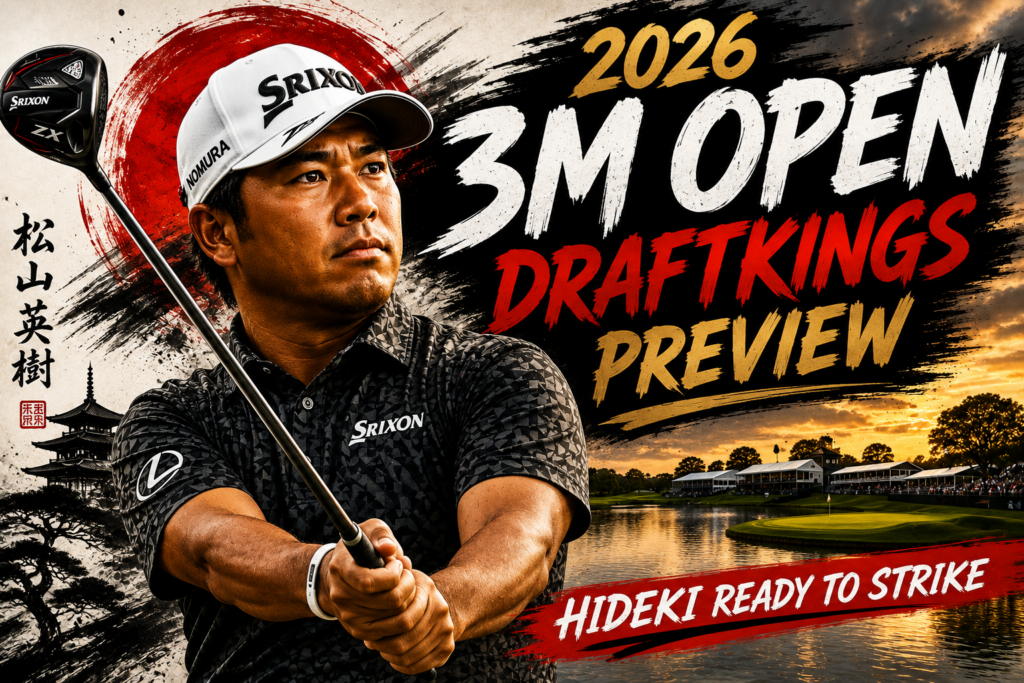
The course history is not impressive, but Matsuyama has not played here in two years, and I am seeing signs that his game is returning to the form he showed late last season and early this year. Outside of Scheffler, Hideki may be the most talented golfer in the entire field. His game can run hot and cold, but I want to get ahead of the field before everything completely clicks again. I will be comfortably overweight at this salary.
Jackson Koivun – $9,200 – Overweight
Koivun burned plenty of people at the John Deere Classic, which could help suppress his ownership this week. This is an upside play built around a golfer who can gain off the tee, attack with his irons and produce strong putting performances. I believe he has enough talent to win this tournament, and the golfers priced directly above him should attract most of the attention. At $9,200, I will gladly take another chance and finish overweight.
Middle Tier
Max Homa – $8,700 – Overweight
Homa played well at the Open Championship after looking excellent at the John Deere Classic, and his ball striking has finally started resembling the version we know he can produce. The recent tee-to-green numbers are extremely encouraging, and this weak field provides a perfect opportunity for him to keep building momentum. I want to be ahead of the field if Homa is truly finding his game again.
Sungjae Im – $8,500 – Slightly Overweight
Sungjae’s iron play has been inconsistent, but he continues to perform well off the tee and showed encouraging numbers throughout his game last week. We already know he can gain significant strokes with the putter when everything starts clicking. In this field, I am willing to bet that the confidence carries over and take a slightly overweight position.
Sam Stevens – $8,400 – Underweight
Stevens possesses obvious upside, but I am seeing too much red throughout his recent statistical profile. Since playing well at the U.S. Open, his approach play has been inconsistent, his off-the-tee numbers have slipped and the putter has not provided much support. I will maintain limited exposure because of the ceiling, but his current form does not justify matching the field.
Johnny Keefer – $7,800 – Overweight
Keefer is a talented 25-year-old who appears to be gradually figuring things out against stronger competition. He flashed his upside at the Byron Nelson and again at the Scottish Open, and his complete skill set gives him several pathways to success at TPC Twin Cities. I want meaningful exposure before the rest of the DFS community fully catches up.
Michael Brennan – $7,700 – Overweight
Brennan fits into a similar category as Keefer as a young golfer whose talent may be developing faster than his reputation. He is an excellent off-the-tee player, gains consistently from tee to green and owns the type of power that can translate perfectly to this course. I believe his upside significantly outweighs the risk at this salary.
Brian Harman – $7,400 – Slightly Underweight
Harman is the kind of experienced veteran who can navigate the course, make the cut and finish somewhere around 28th place. That may be perfectly acceptable in cash games, but it does not provide the ceiling I am hunting in large-field tournaments. He is not a terrible play, but I do not believe a respectable finish will be enough to win anybody a GPP.
Ben Kohles – $7,300 – Overweight
Kohles checks every box this week. He is playing good golf, owns strong course history and remains one of the most reliable tee-to-green players in this range. His accuracy and complete ball striking give him legitimate tournament-winning upside, and we recently saw him enter Sunday with a real opportunity to close one out.
Aldrich Potgieter – $7,400 Overweight
Potgieter has never played here, but his massive distance makes him one of my favorite upside darts on the slate. He should be able to overpower the par fives, create eagle opportunities and generate the type of DraftKings scoring we need from this range.
DFS Outsider Dart Plays
Taylor Moore – $7,300
Moore is not playing his best golf right now, but his course history keeps him firmly in play. His off-the-tee game should fit much better here than it has at some of his recent stops, and he still carries legitimate top-20 upside in this field.
Rico Hoey – $7,200
Hoey continues to flash excellent off-the-tee numbers and does a solid job finding greens. His results here have been mediocre, but this is a pure gut-shot upside play on a golfer whose ball striking can suddenly carry him into contention.
Billy Horschel – $7,000
Horschel is not especially long off the tee, but his approach game remains good enough to compete in a weak field. If he drives it reasonably well, his veteran experience and complete game give him a solid chance to produce a strong finish.
Patrick Fishburn – $6,900
Fishburn owns a T6 at this course and brings the right combination of off-the-tee play, greens in regulation and approach accuracy. At $6,900, he has far more upside than most golfers priced around him.
Zac Blair – $6,900
Blair has already produced a T13 here and made the cut again last season despite being one of the shortest hitters in the field. Dry conditions should provide some additional rollout, and his accuracy, irons and short game can keep him competitive.
David Lipsky – $6,700
Lipsky finished T3 here last year and has already proven that his game can work at TPC Twin Cities. He does enough well throughout the bag to justify taking another chance at this low salary.
Kevin Roy – $6,600
Roy played well at the Genesis Scottish Open and finished T28 here last season. He has enough off-the-tee ability and scoring upside to outperform this salary in a field that becomes thin very quickly.
Cam Davis – $6,400
Davis has played well at this course in the past despite missing the cut last year, and he showed encouraging form at the Scottish Open. At $6,400, he is my deepest shot in the dark and brings far more natural upside than most golfers available in this range.
Frankie’s Fade of the Week: Sungjae Im – $8,500
“Hey, meatballs. Sungjae Im is gonna be more like Sungjae Swim this week. There’s water on 15 holes, his iron game has been all over the place, and you meatballs are ready to jump back in because he had one good week. Bring the floaties.
And calm down with the hype. This is 2026, not 2021. Unless Doc Brown is pulling up to TPC Twin Cities with a time machine, I’m not betting on the version of Sungjae that looked like the next big thing. The guy hasn’t won in five years.
Capisce?”
Final Thoughts
This slate begins and ends with one decision: what the hell are you doing with Scottie Scheffler at $14,900? If you want to play him, play him. He is the best golfer in the field, he has an outstanding chance to win, and fading him always carries risk. I am simply not going to be very high on him because the price forces me to spend the entire weekend praying that five cheap golfers dramatically outperform their salaries.
So once again, two giant middle fingers go directly toward the DraftKings pricing department for finding another way to make a potentially entertaining slate less fun. We should be able to play the best golfer in the world without every lineup looking like Scottie Scheffler and the five cheapest dudes we could find. Instead, I am going to build lineups with six golfers who possess legitimate top ten upside and give myself multiple pathways to the top of the leaderboard.
Find your core, take your stands and do not be afraid to build differently from the field. We have identified the golfers with the power to attack these par fives, the ball striking to create birdie opportunities and the control required to keep the golf ball out of the water. Now it is time to put the right six together, embrace the sweat and go take down a motherfucking GPP.
Good luck this week, Outsiders.
It only takes one