
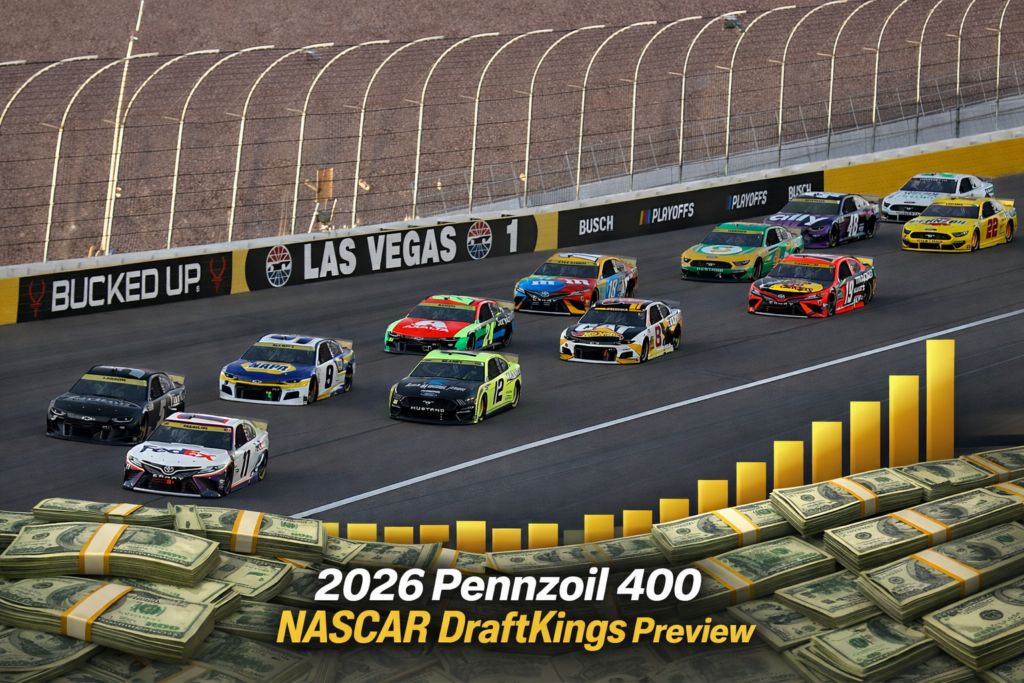

Welcome to the desert, Outsiders. This week the NASCAR Cup Series storms into Las Vegas Motor Speedway, and if there is a track built for speed, chaos, and massive DraftKings scoring potential, this is it. Mile and a half intermediates are where teams start to show their real speed, where long green flag runs reward the fastest cars, and where one or two dominators can completely crack a slate wide open.
Las Vegas Motor Speedway opened in 1996 and the NASCAR Cup Series first arrived in 1998. Since then it has become one of the most important intermediate tracks on the entire schedule because teams use races like this to measure their mile and a half program. When a car shows real speed here it usually means they have something figured out for this style of track, which is why Vegas often gives us an early look at which teams might control the intermediate races throughout the season.
The track itself is a 1.5 mile tri oval with 20 degrees of banking in the turns and 9 degrees on the frontstretch and backstretch. That banking allows drivers to carry tremendous speed through the corners while the wide racing surface opens the door for multiple racing grooves. Drivers can attack the bottom, search for grip through the middle, or build momentum up top, which means the fastest cars tend to work their way forward once long green flag runs begin to settle in.
Today’s race is scheduled for 267 laps which equals 400.5 miles around Las Vegas Motor Speedway, creating a slate with plenty of opportunities for DraftKings scoring. With this many laps on the board, dominators become extremely important because laps led and fastest laps can pile up quickly once a driver gets clean air and begins controlling the pace of the race.
Last season this race delivered a surprise when Josh Berry captured his first career NASCAR Cup Series victory driving for Wood Brothers Racing, a result that reminded everyone that even on a speed track where the fastest cars usually rise to the top, strategy, restarts, and a little chaos can completely flip the outcome.
That is exactly why Las Vegas Motor Speedway matters for DFS players who are willing to think differently. The field will chase the obvious builds, follow projections, and jam the same dominators into their lineups, while the Outsiders look for leverage, understand how these intermediate races actually unfold, and build lineups designed to separate from the herd once the green flag drops.
Now let’s take a look at some historical data. The first table highlights several key performance metrics at Las Vegas Motor Speedway, including stage points, driver rating, laps led, average finish, and DNFs. These numbers help us identify which drivers have consistently performed well at this track and who tends to put themselves in position to score DraftKings points.
The second table takes those same metrics and applies a simple scoring system from best to worst, assigning points across each category and then totaling them up. The goal is not to create a perfect prediction model, but rather to give us a quick snapshot of who has historically shown strength at this track. From there we can start identifying potential core plays, value targets, and leverage spots once we factor in DraftKings salary and projected ownership.
Las Vegas DraftKings Historical Metrics
| Driver | Stage Points | Driver Rating | Laps Led | Average Finish | DNFs | Starting Position |
|---|---|---|---|---|---|---|
| Kyle Larson | 80 | 128.7 | 568 | 4.3 | 0 | 5 |
| William Byron | 69 | 113.0 | 258 | 10.3 | 1 | 9 |
| Christopher Bell | 57 | 101.7 | 216 | 9.5 | 0 | 1 |
| Denny Hamlin | 51 | 97.2 | 62 | 10.5 | 0 | 2 |
| Tyler Reddick | 50 | 98.6 | 48 | 14.8 | 1 | 7 |
| Ross Chastain | 29 | 89.9 | 16 | 9.3 | 0 | 17 |
| Austin Cindric | 28 | 67.9 | 47 | 18.2 | 0 | 31 |
| Bubba Wallace | 28 | 77.2 | 25 | 19.0 | 0 | 4 |
| Brad Keselowski | 23 | 75.2 | 45 | 15.2 | 1 | 28 |
| Chase Elliott | 21 | 70.3 | 0 | 21.0 | 1 | 15 |
| Ryan Blaney | 19 | 74.6 | 4 | 21.2 | 2 | 6 |
| Kyle Busch | 16 | 79.3 | 21 | 16.2 | 0 | 24 |
| Ty Gibbs | 16 | 71.4 | 23 | 24.5 | 1 | 3 |
| Carson Hocevar | 16 | 62.9 | 6 | 27.2 | 2 | 19 |
| Joey Logano | 14 | 91.6 | 58 | 13.2 | 0 | 21 |
| Chris Buescher | 13 | 70.4 | 2 | 17.3 | 1 | 10 |
| Chase Briscoe | 13 | 60.2 | 58 | 21.5 | 0 | 18 |
| Daniel Suarez | 7 | 80.9 | 84 | 10.2 | 0 | 13 |
| Josh Berry | 6 | 61.7 | 18 | 20.0 | 0 | 32 |
| AJ Allmendinger | 5 | 71.1 | 0 | 16.5 | 0 | 29 |
| Austin Dillon | 4 | 51.3 | 0 | 25.8 | 1 | 11 |
| Ryan Preece | 1 | 62.2 | 0 | 17.7 | 0 | 8 |
| Ricky Stenhouse Jr | 1 | 55.8 | 0 | 20.8 | 0 | 23 |
| Erik Jones | 1 | 55.3 | 1 | 21.3 | 1 | 14 |
| Riley Herbst | 0 | 45.4 | 0 | 18.0 | 0 | 20 |
| Noah Gragson | 0 | 62.7 | 0 | 19.6 | 1 | 34 |
| Michael McDowell | 0 | 59.5 | 9 | 19.8 | 0 | 30 |
| John Hunter Nemechek | 0 | 54.5 | 0 | 20.0 | 0 | 26 |
| Zane Smith | 0 | 49.9 | 0 | 24.8 | 0 | 12 |
| Cole Custer | 0 | 41.9 | 1 | 27.0 | 0 | 35 |
| Todd Gilliland | 0 | 39.0 | 1 | 27.2 | 0 | 27 |
| Cody Ware | 0 | 29.8 | 0 | 31.8 | 2 | 33 |
| Shane Van Gisbergen | 0 | 42.6 | 0 | 32.0 | 2 | 16 |
Las Vegas DraftKings Points Assessment
| Driver | Stage Pts | Rating | Laps Led | Avg Finish | Start Pos | Total |
|---|---|---|---|---|---|---|
| Kyle Larson | 3 | 3 | 3 | 3 | 1 | 13 |
| William Byron | 3 | 3 | 3 | 3 | 1 | 13 |
| Christopher Bell | 3 | 3 | 3 | 3 | 1 | 13 |
| Denny Hamlin | 3 | 3 | 3 | 3 | 1 | 13 |
| Tyler Reddick | 3 | 3 | 3 | 2 | 1 | 12 |
| Ross Chastain | 3 | 3 | 2 | 3 | 2 | 13 |
| Austin Cindric | 3 | 2 | 3 | 2 | 3 | 13 |
| Bubba Wallace | 3 | 3 | 2 | 2 | 1 | 11 |
| Brad Keselowski | 3 | 2 | 3 | 2 | 3 | 13 |
| Chase Elliott | 3 | 2 | 2 | 2 | 2 | 11 |
| Ryan Blaney | 3 | 2 | 2 | 2 | 1 | 10 |
| Kyle Busch | 3 | 2 | 2 | 2 | 2 | 11 |
| Ty Gibbs | 3 | 2 | 2 | 1 | 1 | 9 |
| Carson Hocevar | 3 | 2 | 2 | 1 | 2 | 10 |
| Joey Logano | 3 | 3 | 3 | 2 | 2 | 13 |
| Chris Buescher | 3 | 2 | 2 | 2 | 1 | 10 |
| Chase Briscoe | 3 | 2 | 3 | 2 | 2 | 12 |
| Daniel Suarez | 2 | 2 | 3 | 3 | 2 | 12 |
| Josh Berry | 2 | 2 | 2 | 2 | 3 | 11 |
| AJ Allmendinger | 2 | 2 | 1 | 2 | 3 | 10 |
| Austin Dillon | 2 | 1 | 1 | 1 | 2 | 7 |
| Ryan Preece | 2 | 2 | 1 | 2 | 1 | 8 |
| Ricky Stenhouse Jr | 2 | 1 | 1 | 2 | 2 | 8 |
| Erik Jones | 2 | 1 | 1 | 2 | 2 | 8 |
| Riley Herbst | 1 | 1 | 1 | 2 | 2 | 7 |
| Noah Gragson | 1 | 2 | 1 | 2 | 3 | 9 |
| Michael McDowell | 1 | 2 | 2 | 2 | 3 | 10 |
| John Hunter Nemechek | 1 | 1 | 1 | 2 | 3 | 8 |
| Zane Smith | 1 | 1 | 1 | 1 | 2 | 6 |
| Cole Custer | 1 | 1 | 2 | 1 | 3 | 8 |
| Todd Gilliland | 1 | 1 | 2 | 1 | 3 | 8 |
| Cody Ware | 1 | 1 | 1 | 1 | 3 | 7 |
| Shane Van Gisbergen | 1 | 1 | 1 | 1 | 2 | 6 |
Elite Core Plays
Kyle Larson $11000 overweight
The Vegas metrics are impossible to ignore. He leads the field in stage production, driver rating, and laps led by a mile, and starting fifth gives him immediate dominator potential. Larson just has a knack for Las Vegas Motor Speedway, and this is the type of track where he can dominate from start to finish. If he finds his way to the front, he might not look back. The real question is how much of him is too much?
Christopher Bell $10700 underweight
Bell showed excellent speed in qualifying and starts on the pole, but the lack of place differential and expected ownership makes this a spot where I will come in slightly under the field. A lot of the attention is going to land on Larson and Bell this week, and I simply like Larson more in this spot.
Denny Hamlin $10500 on par
If you are looking to get different at the top of the slate, Hamlin could be the pivot play. He likes Las Vegas Motor Speedway and has the type of experience that can allow him to control long stretches of a race like this. With so much ownership likely flowing to Larson and Bell, Hamlin becomes an interesting leverage option that could separate you from the field.
William Byron $10000 overweight
Outside of Larson, Byron carries tremendous upside in this field. Starting ninth gives him plenty of room to move forward, and if he finds himself near the front he absolutely has the speed to run with the leaders.
Tyler Reddick $9500 overweight
Reddick has been extremely strong on intermediates and still looked good last week. Starting seventh gives him a realistic path to run near the front all day.
Chase Briscoe $9200 overweight
Briscoe has not finished well here but has shown flashes of speed at this track. This could easily be the race where he finally gets his season moving in the right direction, and he also profiles as a spot where you can get a little different from the field.
Chase Elliott $9000 underweight
Vegas has not historically been one of Elliott’s better tracks. Starting fifteenth provides some upside but this is not a spot where I plan to go heavy.
Bubba Wallace $8200 on par
Wallace has quietly been very consistent at Las Vegas Motor Speedway and starts fourth. If he holds track position early, he could easily return value in this price range.
Josh Berry $7700 on par
Last year’s winner starts thirty second which gives massive place differential potential. It is very hard to ignore that upside at this price point.
Ryan Preece $7500 underweight
Starting eighth limits the place differential ceiling and makes the risk higher than the reward in this spot.
Austin Cindric $7200 overweight
Starting thirty first creates a ton of place differential potential. If the car has even moderate speed he could easily work his way into optimal builds.
Brad Keselowski $6900 overweight
Starting twenty eighth gives strong place differential upside and his experience at Las Vegas Motor Speedway makes him a very appealing mid tier tournament option.
Shane Van Gisbergen $6300 underweight
The hype has been high early in the season, but starting sixteenth limits the upside here. It is difficult to see a clear path to a true ceiling performance.
AJ Allmendinger $6100 overweight
Starting twenty ninth gives strong place differential potential. A clean race with a top twenty finish could easily put him into the optimal lineup.
John Hunter Nemechek $6000 on par
A cheap player that if he gets inside the top 20 could find the optimal build.
Austin Dillon $5800 underweight
Starting eleventh limits the upside and this simply is not a driver I want much exposure to on this slate.
Noah Gragson $5500 overweight
Starting thirty fourth gives significant place differential potential. A solid dark horse play who could sneak into the top twenty.
Ty Dillon $5300 overweight
Starting thirty sixth creates massive place differential upside if he simply keeps the car clean and finishes the race.
Final Thoughts
This slate creates some really interesting lineup construction decisions. If Kyle Larson goes out and dominates the race the way the metrics suggest he could, he will likely end up in a huge percentage of optimal builds. That will naturally create a lot of similar lineup constructions, so the real question becomes how you build around him.
To get to three of the expensive drivers at the top, you are probably going to have to make sacrifices somewhere else. That could mean playing only one mid range driver and pairing them with two cheaper options, or building more balanced lineups with two elite drivers and a heavier middle tier.
Drivers like Brad Keselowski, Bubba Wallace, and Austin Cindric sit right in that decision making zone where they can completely shape the way your roster is constructed. Choosing the right combination in that range could end up being the difference in the slate.
Leaving a little salary on the table may also be a viable strategy this week. With Larson expected to anchor many builds, finding ways to differentiate your lineup construction could be the key to separating from the field.
Overall this is a really interesting slate with a lot of moving parts. There are multiple ways to build competitive lineups, but if you are playing the chalkier drivers you will likely need to get creative somewhere else in order to truly separate from the field.
Let’s have a great day of racing and go get us a fucking GPP win because…
IT ONLY TAKES ONE! GOOD LUCK!