
The Great American Race Is Here
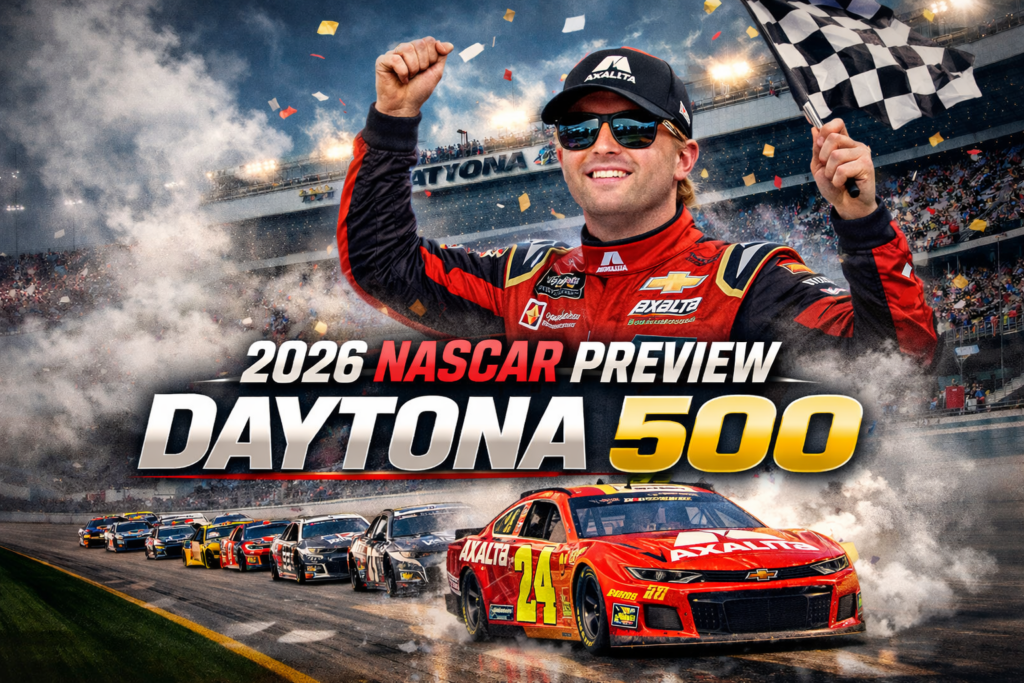
Buckle up and start your engines. The Great American Race at Daytona is here, and with it comes the official kickoff to the NASCAR season. There’s no other race like this one. Pack racing, drafting, bumping, and grinding at nearly 200 miles an hour means one tiny mistake can wipe out half the field in a heartbeat, keeping fans on edge from the moment the green flag drops. Pit stops come fast and furious, and one slip on pit road can drop a driver out of the draft and send a winning car straight to the back of the pack with no way to recover.
Daytona is also where teamwork matters, at least for a while. Manufacturers and teammates work together to stay organized in the draft, but when the laps wind down, alliances disappear. Nobody has friends when the white flag waves. Every driver in the field is chasing the same goal, taking the checkered flag and starting their season with momentum, while defending champion Kyle Larson enters the year looking to back up his 2025 title with another championship run.
And one of the biggest early storylines centers around William Byron, winner of this race the last two seasons, who will roll off from the rear of the field this time around. At almost any other track, starting deep in the pack would be a major disadvantage, but Daytona plays by its own rules. Here, starting in the back can actually work in a driver’s favor since there’s nowhere to go but forward, and the draft allows fast cars to move through traffic much easier than at traditional tracks. That makes Byron’s path back to the front one of the most fascinating angles to watch on Sunday.
One big twist entering this season is the playoff format change. A lucky superspeedway win no longer guarantees a postseason spot, meaning a surprise Daytona victory doesn’t automatically punch a playoff ticket anymore. It still gives teams a massive points boost and momentum to build on, but now consistency over the entire season matters more than ever. And that changes how drivers approach races like Daytona right from the start.
NASCAR Championship Format Reset — The Chase Returns
One of the biggest changes heading into 2026 is NASCAR moving back to the classic Chase championship format. The elimination-style playoff system is gone, and we’re back to rewarding drivers who perform all season long instead of handing out automatic postseason spots for a single lucky win.
That means a Daytona 500 winner or a surprise superspeedway victory no longer guarantees a playoff berth. Drivers now have to earn their way in through consistency across the full season. Wins still matter, though. A victory now pays 55 points instead of 40, so strong teams can still climb the standings quickly, but one big day alone won’t punch your ticket anymore.
Here’s how the postseason field now looks across each series.
Cup Series. Top 16 drivers in points advance to The Chase.
O’Reilly Auto Parts Series, formerly the Xfinity Series. Top 12 drivers advance.
Craftsman Truck Series. Top 10 drivers advance.
Once drivers make The Chase, they stay in. No more sudden eliminations or bracket cutoffs like the previous format. It becomes a straight championship battle based on performance rather than survival rounds.
Stage racing also stays the same. Stage points and finishing position points remain unchanged, with up to 10 points available per stage, so drivers still have reason to push hard throughout each race rather than only at the finish.
Cup Series Chase Seeding Points
When the regular season ends, Chase drivers receive a points reset with tiered advantages based on standings.
Seed 1 starts with 2100 points
Seed 2 starts with 2075 points
Seed 3 starts with 2065 points
Seed 4 starts with 2060 points
Seed 5 starts with 2055 points
Seed 6 starts with 2050 points
Seed 7 starts with 2045 points
Seed 8 starts with 2040 points
Seed 9 starts with 2035 points
Seed 10 starts with 2030 points
Seed 11 starts with 2025 points
Seed 12 starts with 2020 points
Seed 13 starts with 2015 points
Seed 14 starts with 2010 points
Seed 15 starts with 2005 points
Seed 16 starts with 2000 points
Bottom line, consistency matters again. Wins still carry real weight, but there are no more free playoff passes. Drivers have to perform all year to stay in the hunt. No shortcuts, no lucky tickets, and no coasting into the postseason.
And honestly, I’m a fan of the move. Going back to this format rewards the driver who performs the best across the entire season, which is exactly how a championship should be decided. It shouldn’t come down to one late-season roulette spin where someone steals a title at a track that happens to fit them while drivers who dominated for months get knocked out. Over the long haul, the best team should win, and this format brings NASCAR back in line with that idea.
Competition Package Updates and What They Mean
NASCAR is also tweaking the competition package entering 2026, particularly around horsepower levels and aero balance on certain track types. Short tracks and some intermediate tracks will see adjustments aimed at improving passing and reducing the aero dependency that has made it tough for drivers to move through the field in recent seasons. More horsepower and slightly reduced aero grip at these venues should, in theory, put more control back in the driver’s hands and make mechanical grip matter again.
For racing fans, that ideally means more side-by-side battles and less single-file aero trains. For DFS purposes, it could create slightly more volatility as driver skill and tire management play a bigger role rather than pure track position dictating outcomes. We’ll see quickly if NASCAR finally found the right balance, but the goal is clearly better racing, especially on tracks that struggled with passing last year.
NASCAR is also lowering participation barriers for younger talent, allowing drivers as young as 17 to compete in select national series events under updated eligibility rules. That opens the door for elite prospects to move up faster, injecting more young talent into the pipeline sooner than in past seasons.
Driver, Manufacturer, Crew Chief, and Team Changes
Cup Series Changes
The Cup garage didn’t see massive turnover this offseason, but a few key moves could still shift the competitive picture early in the year.
Connor Zilisch joins Trackhouse Racing full-time, replacing Daniel Suárez.
Daniel Suárez moves to Spire Motorsports for 2026.
Justin Haley departs Spire Motorsports and steps away from a full-time Cup ride.
Haas Factory Team and Rick Ware Racing switch manufacturer support to Chevrolet.
Jim Pohlman moves up as crew chief for Kyle Busch at Richard Childress Racing.
O’Reilly Auto Parts Series Changes
The O’Reilly Series continues to serve as NASCAR’s proving ground, and several drivers change seats as development pipelines shuffle entering 2026.
Corey Day joins Hendrick Motorsports full-time.
Nick Sanchez moves to AM Racing’s No. 25 Ford entry.
Sammy Smith returns full-time with JR Motorsports.
Brent Crews begins a full season with Joe Gibbs Racing.
Gio Ruggiero appears in select early-season starts with Joe Gibbs Racing.
Harrison Burton moves to Sam Hunt Racing.
Rajah Caruth expands his schedule with Jordan Anderson Racing.
Craftsman Truck Series Changes
The biggest headline entering the Truck season is simple. Dodge is back in NASCAR competition, returning to the Truck Series and adding fresh manufacturer support and opportunities for drivers and teams.
Justin Haley returns to the Truck Series full-time.
Daniel Dye returns to full-time Truck competition.
Christian Eckes moves back to McAnally-Hilgemann Racing full-time.
Landen Lewis runs a part-time Truck schedule with Niece Motorsports.
Tyler Ankrum returns full-time with McAnally-Hilgemann Racing.
Tyler Reif becomes the primary driver of Niece Motorsports’ No. 42 entry.
Layne Riggs continues full-time with Front Row Motorsports.
DraftKings NASCAR DFS Scoring Basics
Before diving into lineup strategy, here’s a quick refresher on how DraftKings NASCAR scoring works and why starting position matters so much.
Place Differential: ±1 point per position
Drivers earn one point for every spot they gain from their starting position and lose one point for every spot they drop. A driver starting 30th and finishing 10th earns +20 points. A driver starting first and finishing 11th loses 10 points.
Fastest Laps: +0.45 points each
Laps Led: +0.25 points per lap led
Finishing Position Points
Last place earns one point, with each position forward earning one additional point, and the race winner receiving a three-point bonus on top.
Scoring Notes
Finishing position is based on the official result at the checkered flag, and post-race inspection penalties do not change DFS scoring. Starting position is based on qualifying results, even if a driver moves to the rear for non-qualifying reasons.
Daytona Qualifying Recap
Qualifying once again showed how razor-thin the margins are at Daytona. Kyle Busch grabbed the pole with a qualifying lap averaging over 183 miles per hour, while Chase Briscoe secured the outside front row.
Thursday night’s Duel races then set the remainder of the field, delivering two aggressive, strategy-filled battles packed with drafting moves, pit strategy, and late position swaps that locked in the starting lineup for Sunday.
Daytona DFS Strategy: Embrace the Chaos
Daytona is chaos. Multi-car wrecks, late-race pileups, and pit road mistakes routinely turn contenders into scrap metal. Survival matters as much as speed, making this race one of the most unpredictable DFS slates of the year.
Some drivers consistently work their way to the front in drafting races, including Denny Hamlin, Chase Briscoe, and Joey Logano, while superspeedway standouts like Bubba Wallace, Alex Bowman, Ricky Stenhouse Jr., Michael McDowell, and Austin Cindric repeatedly find success in the draft.
Ownership becomes a huge factor this week. Drivers starting deep in the field such as Chris Buescher, William Byron, Connor Zilisch, Bubba Wallace, and Denny Hamlin will draw heavy attention, making it important to balance chalk exposure with contrarian plays like Justin Allgaier, Anthony Alfredo, Ty Dillon, Cody Ware, Corey Heim, and Riley Herbst.
Pole sitter Kyle Busch offers limited place differential upside, while drivers starting just behind him like Chase Briscoe, Joey Logano, and Chase Elliott could still control portions of the race. Mid-pack drivers such as John Hunter Nemechek, Michael McDowell, Ricky Stenhouse Jr., Todd Gilliland, and Ryan Preece also present interesting value options.
Balance is key. Pair drivers who can lead laps with drivers who can move forward from deeper starting spots. Build multiple lineups, leave salary unused to stay unique, and don’t be afraid to get creative.
Final Thoughts: Build Smart, Have Fun, Embrace the Madness
I know we just ran through a ton of driver names, so here’s the real moral of the story.
If you build a lineup stacked with nothing but the obvious chalk plays at every tier, you’re probably not winning anything meaningful. And even if you do, you’ll be splitting the payout with a pile of other lineups that look exactly the same. And who wants to split a Daytona win? Not me.
The truth is, Daytona is one of the hardest races on the calendar to predict. I honestly like my chances picking winners at Bristol or a road course far more than I do here, simply because of how unpredictable superspeedway racing is. That doesn’t make it bad. In fact, it’s one of the most exciting races to watch all year. The atmosphere, the speed, the drafting, the chaos, it’s all part of why Daytona is special. But for DFS, the key is simply making sure you’ve got horses in the race when it matters.
You’re almost always going to need drivers starting deeper in the field who can move forward. Lineups filled with drivers all starting in the top 15 rarely win these slates because they have limited place differential upside. Sure, sometimes chaos strikes early and wipes out the back half of the field, but more often the big wrecks happen later, when tensions rise and drivers start making desperate moves. By then, the field has shuffled multiple times, lanes have swapped, lines break apart, and drivers cycle forward and backward constantly.
And while it might not always look like it, there is a ton of movement happening throughout the race. Sometimes it’s one car falling back, sometimes an entire lane loses momentum. The drivers who understand how to manage those swings and make smart drafting decisions are usually the ones still around at the end. That’s why names like Chase Briscoe, Joey Logano, Chase Elliott, Austin Dillon, Michael McDowell, Ricky Stenhouse Jr., Alex Bowman, Denny Hamlin, Bubba Wallace, Austin Cindric, William Byron, and Chris Buescher always deserve attention on superspeedways. Those guys consistently find ways to navigate the madness.
The trick is pairing those strong superspeedway racers with the right complementary pieces. Drivers starting in the back who can simply move forward and survive become just as important as the favorites. Sometimes ugly cars survive while faster ones don’t. Sometimes the back half avoids a wreck that wipes out the leaders. Daytona rewards flexibility and creativity more than precision.
This is also a great week to spread exposure. Build multiple lineups. Throw some darts. Play some lower-stakes contests and take a few swings at bigger tournaments because anything can happen here. More lineups simply give you more chances to be alive when chaos unfolds.
And beyond DFS, it’s just great to have racing back. Daytona always delivers drama, and the upcoming season should be even better with added horsepower and competition tweaks aimed at improving racing across short tracks and road courses. NASCAR is clearly trying to put more action back in the drivers’ hands, and that should make for a fun year ahead.
Bottom line, enjoy the race, have some fun with your builds, and don’t be afraid to get a little weird with lineup construction. Daytona is the perfect place to take those shots. Good luck on Sunday!!
Now let’s go racing.